If you start learning Korean, there is a moment when you may think:
“Why are there so many ways to say the same thing?”
In English, you can usually say:
“Thank you.”
to your friend, your teacher, your boss, a stranger, or an elderly person.
Korean is different.
You might hear:
고마워.
고마워요.
감사합니다.
고맙습니다.
They can all be translated as “Thank you.”
But they do not always feel the same.
The difference is not simply grammar.
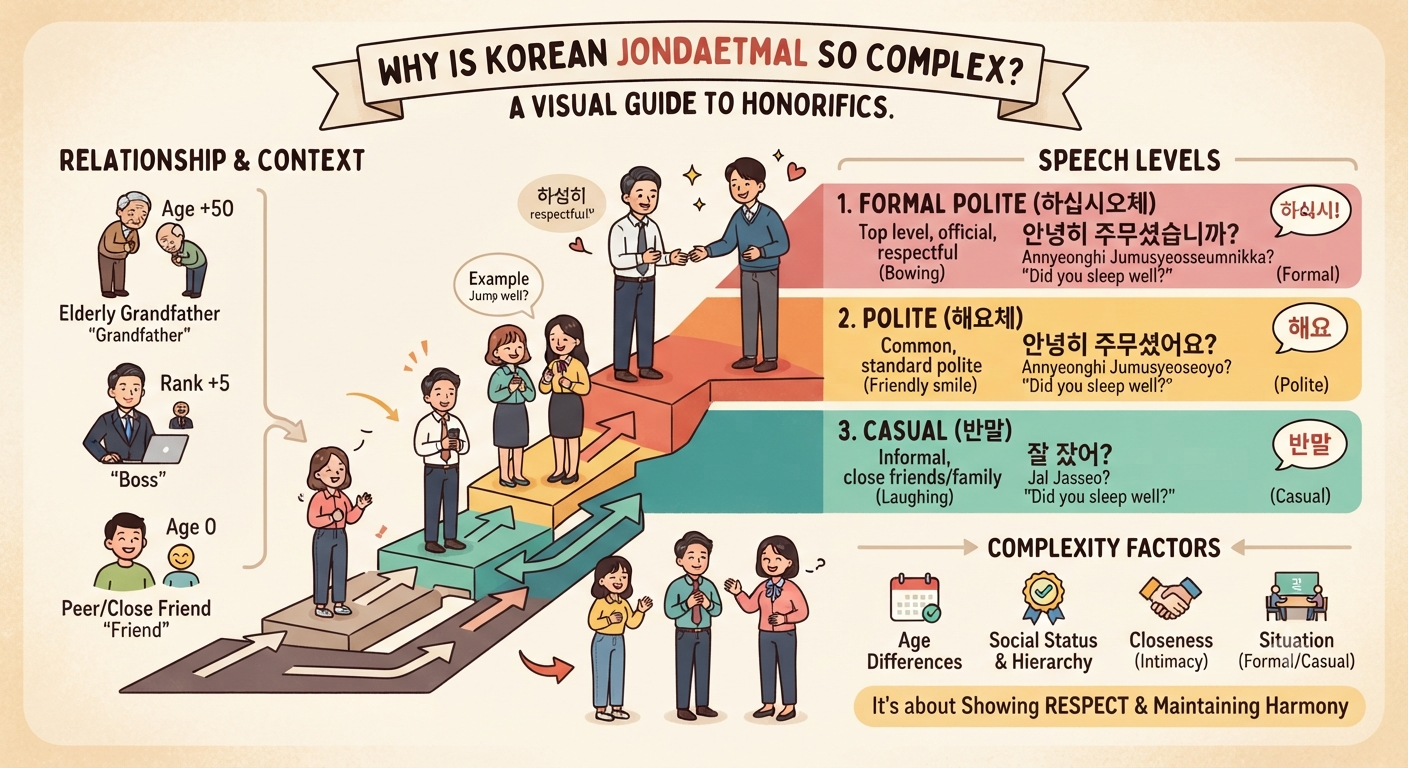
Korean speech reflects age, social position, familiarity, politeness, situation, and the relationship between the people speaking.
That is why Korean honorifics can seem incredibly complicated to foreigners.
But there is actually a logic behind them.
🇰🇷 Korean Is Not Just About What You Say
One of the biggest differences between Korean and English is that Korean often asks you to consider who you are talking to before you choose your words.
Imagine you want to say:
“Are you going home?”
Depending on the situation, you could say:
집에 가?
Casual.
집에 가요?
Polite everyday speech.
집에 가세요?
Polite and potentially honorific.
집에 가십니까?
Very formal.
The basic idea is the same.
But the relationship changes the expression.
So learning Korean is not simply:
English word → Korean word
It is closer to:
Meaning + relationship + situation → Korean expression
That extra calculation is one reason Korean can feel difficult.
👥 Age Matters More Than Many Foreigners Expect
Age is one of the most noticeable factors.
If two Koreans are close friends and similar in age, they may use casual speech.
But if one person is significantly older, the younger person will often use polite speech, especially when they are not close.
This does not mean that every older person automatically demands formal language.
Relationships can change the rules.
For example, two people who first meet may use polite speech even if they later become close friends.
After becoming closer, one person may say:
말 놓을까요?
“Shall we speak casually?”
This is an important moment.
It means the relationship is becoming more informal.
🗣️ “Speaking Casually” Is a Social Step
Korean has an interesting concept called 말 놓다, which literally means something like “put down the speech.”
In everyday conversation, it means moving from polite speech to casual speech.
Someone might say:
우리 말 놓을까요?
“Shall we speak casually?”
This can happen between friends, coworkers, classmates, or people who have become comfortable with each other.
For a foreigner, this can be surprising.
In English, becoming friends usually does not require an explicit conversation about changing your grammar.
In Korean, the change can be much more visible.
The way you speak can literally change as the relationship develops.
🎭 Politeness Is Not One Single System
This is where Korean becomes especially confusing.
People sometimes call everything “honorifics.”
But Korean actually has several related systems.
One involves showing respect toward the person you are talking about.
Another involves choosing an appropriate speech level toward the listener.
There are also special vocabulary forms.
For example:
먹다
means “to eat.”
But when respectfully referring to someone else's eating, you may hear:
드시다
This is not simply changing the ending.
The verb itself changes.
Similarly:
자다 → 주무시다
“to sleep” → respectful “to sleep”
있다 → 계시다
“to be/exist” → respectful form
These special words can make Korean feel like it has a completely separate vocabulary for older or higher-status people.
🙇 The Listener and the Subject Are Not Always the Same
This is one of the most important concepts for Korean learners.
Korean can show respect toward the person being talked about, not only the person being spoken to.
Imagine you are talking to a friend about your teacher.
You might say:
선생님이 오세요.
Literally, something like:
“Teacher is coming.”
The ending and verb form can show respect toward the teacher.
But you are talking to your friend.
So there are actually two relationships being considered:
You ↔ your friend
and
You ↔ the teacher being discussed
English usually does not mark these relationships grammatically in the same way.
Korean can.
👔 The Workplace Makes Everything More Complicated
Imagine a Korean company.
There may be:
- a new employee
- a senior employee
- a manager
- a department head
- an executive
They may all be adults.
They may even be friends outside work.
But inside the workplace, speech can still reflect organizational roles.
A junior employee might say:
확인했습니다.
“I have checked it.”
rather than a casual:
확인했어.
“I checked it.”
The second expression may be perfectly normal between close friends.
But in a professional situation, it can sound far too casual.
This is why foreigners working in Korea often discover that textbook Korean is not enough.
You also need to understand social context.
📱 Text Messages Are Changing Korean Politeness
Modern Korean communication has made things even more interesting.
People now communicate through:
- KakaoTalk
- text messages
- social media
- workplace messaging apps
- online communities
Written Korean does not always follow traditional formal speech patterns.
For example, someone might write:
네 ㅎㅎ
instead of a full formal sentence.
Or:
알겠습니다!
Or:
넵!
Or simply:
네.
These expressions can have different emotional tones even though they all broadly communicate agreement or acknowledgment.
The number of characters, punctuation, emojis, and endings can affect how polite or friendly the message feels.
😊 “요” Is Extremely Important
For beginners, one of the most useful Korean endings is:
-요
It appears constantly in everyday polite conversation.
For example:
먹어요.
가요.
좋아요.
괜찮아요.
있어요.
This style is polite but not excessively formal.
That makes it extremely useful.
If you are unsure how to speak to someone in Korea, -요 speech is often a safer starting point than casual speech.
It can be used with strangers, acquaintances, coworkers, shop employees, neighbors, and many other people.
Of course, the exact situation matters.
But as a general learning strategy, mastering everyday -요 speech is extremely valuable.
🏢 Then There Is Formal Speech
Korean also has a more formal style.
You may hear:
합니다
갑니다
먹습니다
감사합니다
알겠습니다
This style is common in:
- presentations
- news broadcasts
- official announcements
- business situations
- military communication
- customer service
- formal meetings
- public speaking
It can sound more distant or official than everyday -요 speech.
Interestingly, formal speech is not necessarily “more respectful” in every situation.
Sometimes it simply means:
“This is a formal setting.”
That distinction is important.
🧑🤝🧑 Close Friends Can Speak Very Differently
Once people become close, they may use casual speech.
For example:
뭐 해?
“What are you doing?”
밥 먹었어?
“Did you eat?”
어디 가?
“Where are you going?”
These expressions are perfectly natural between close friends.
But if you say them to a stranger or someone much older without permission, they can sound rude.
The words themselves are not inherently rude.
The relationship determines whether they are appropriate.
This is one of the hardest concepts for English speakers to develop naturally.
❤️ Korean Politeness Is Also About Distance
You can think of Korean speech as having different levels of social distance.
Very roughly:
Stranger → acquaintance → coworker → friend → close friend
The closer the relationship becomes, the more casual speech may become.
But there are exceptions.
A close relationship does not automatically eliminate politeness.
For example, a child may use polite speech with parents in some families.
A married couple may sometimes use polite speech with each other.
Friends may switch between casual and polite speech depending on the situation.
Korean speech is therefore not a simple ladder.
It is more like a social map.
🔄 Koreans Can Switch Speech Levels During One Conversation
This can be confusing for foreigners.
A Korean speaker might start with:
안녕하세요.
“Hello.”
Then use polite speech.
Later, after becoming comfortable:
이름이 뭐예요?
“What is your name?”
Then perhaps:
우리 말 놓을까요?
“Shall we speak casually?”
After that:
어디 살아?
“Where do you live?”
The grammar changed because the relationship changed.
Sometimes the switch can happen gradually rather than all at once.
And sometimes people intentionally switch speech levels for humor, teasing, seriousness, or emotional emphasis.
😅 Being Too Polite Can Also Sound Strange
You might assume:
“If polite speech is good, I'll always use the most formal Korean possible.”
But this can also cause problems.
Imagine a close friend speaking to you every day with extremely formal language:
식사하셨습니까?
“Have you eaten?”
It is grammatically correct.
But between close friends, it may sound stiff, distant, or even joking.
So the goal is not:
“Use the most polite Korean possible.”
The goal is:
“Use the appropriate level of politeness for the relationship and situation.”
That is a much better way to understand Korean.
👵 Why Is Age So Important?
The historical background matters.
Korean society was strongly influenced by Confucian ideas about:
- age
- family hierarchy
- social roles
- respect
- responsibility
- seniority
These ideas influenced language as well as behavior.
Korean developed linguistic ways to express relationships that English generally does not mark grammatically.
Modern Korea has changed enormously.
Young people may value equality and individual choice much more than previous generations.
But the linguistic system remains.
That is why a modern Korean teenager can live in a highly modern society while still changing speech depending on someone's age.
🌏 Is Korean Unique?
No.
Many languages have formal and informal speech.
Japanese is another well-known example.
Some European languages also distinguish between formal and informal forms of “you.”
But Korean is particularly noticeable because age, social hierarchy, honorific vocabulary, speech levels, and sentence endings can interact at the same time.
This makes the system feel more complicated to a beginner.
The good news is that native speakers are not consciously calculating every rule every second.
They develop an intuitive sense of what sounds natural.
Foreign learners need time to develop that intuition too.
🧠 Why Textbooks Cannot Explain Everything
A textbook may tell you:
친구에게는 반말을 사용하세요.
“Use casual speech with friends.”
But real life is more complicated.
What if the friend is ten years older?
What if you met yesterday?
What if you are coworkers?
What if your friend is your boss?
What if you are joking?
What if you're angry?
What if you're speaking in front of other people?
The correct speech level can change with the situation.
That is why Korean learners often need to learn situations, not just grammar rules.
🗣️ A Useful Rule for Foreigners in Korea
If you're not sure how to speak to someone, starting politely is usually safer than starting casually.
For example:
안녕하세요.
괜찮아요?
어디 가세요?
감사합니다.
These are useful, natural expressions.
Then pay attention to how the other person speaks to you.
If the relationship becomes closer, they may suggest using casual speech.
You can also ask:
말 놓아도 돼요?
“Is it okay if I speak casually?”
This is much better than guessing.
❤️ The Deeper Meaning of Korean Politeness
Korean honorifics are sometimes described as a complicated grammar system.
That is true.
But they are also a way of constantly acknowledging relationships.
When you change your speech, you are communicating:
“I know who you are.”
“I understand our relationship.”
“I recognize the situation.”
“I am adjusting how I speak accordingly.”
That is why a Korean speaker may immediately notice when a foreigner uses the wrong speech level.
The sentence may be grammatically perfect.
But socially, it may feel slightly strange.
🇰🇷 So Why Is Korean Polite Speech So Complicated?
Because Korean does not treat language as completely separate from relationships.
English often lets you say the same basic sentence to many different people.
Korean frequently asks you to consider:
Who am I talking to?
How old are they?
How close are we?
What is their position?
Who am I talking about?
Where are we?
Is this formal or casual?
What feeling do I want to express?
Then you choose the appropriate ending or vocabulary.
That sounds complicated.
And for a beginner, it absolutely is.
But there is a simpler way to understand it.
Korean politeness is not really about finding the “most polite” sentence.
It is about finding the right relationship between the speaker, the listener, and the situation.
Once you understand that, Korean honorifics stop looking like hundreds of random grammar rules.
They start looking like a map of Korean social relationships.
And that is why learning Korean is not only learning a language.
It is also learning how Koreans position themselves in relation to other people.
'About Life in Korea > Korean Language & Mindset' 카테고리의 다른 글
| Why Do Koreans Use Job Titles Instead of Names? (0) | 2026.10.07 |
|---|---|
| Why Are Titles and Forms of Address So Important in Korea? (0) | 2026.10.06 |
| Why Do Koreans Ask Your Age So Quickly? (0) | 2026.10.03 |
| Why Can Casual Korean Speech Feel Rude? (0) | 2026.10.01 |
| Why Is the End of a Sentence So Important in Korean? (0) | 2026.09.29 |


댓글